
Mission and vision
The Vision and Strategy for 2025-2050
With NZ Government not having an Energy Strategy Bioenergy Association has been leading implementation of a Bioenergy Vision and Strategy (BANZ30) developed across the whole of the NZ economy. Priorities are on utilising biomass and organic waste material to produce energy and other economic and societal benefits.
(Click on image to view full size)
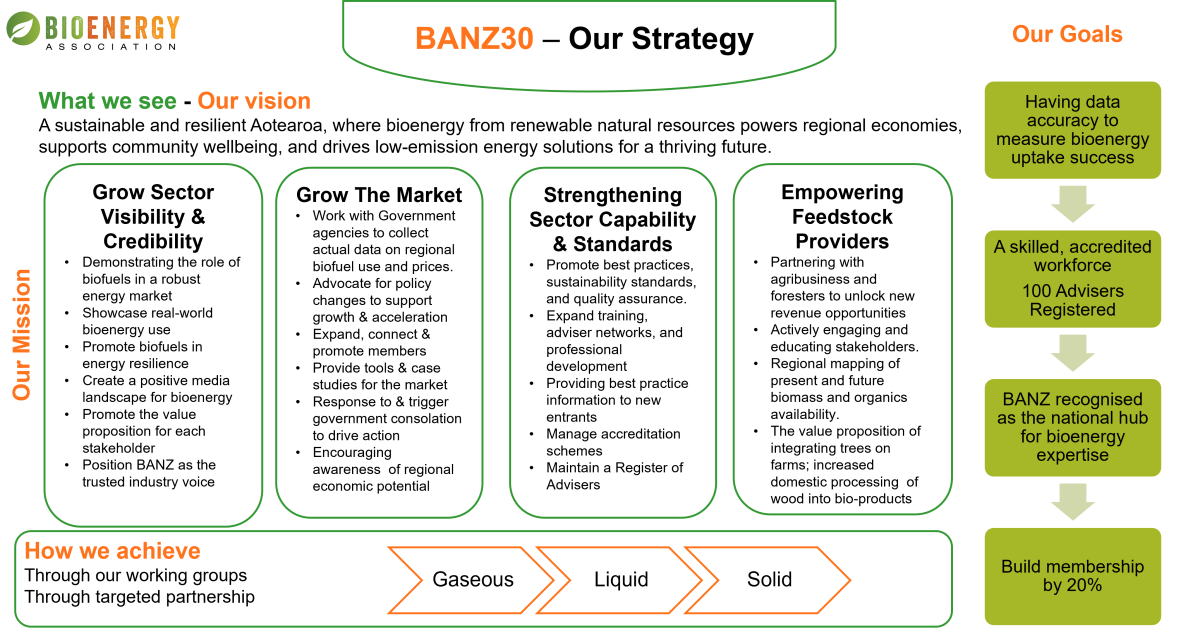
The BANZ30 Strategy sets a platform for priorities for 2026/27. This sets out a pathway across the biogas, wood energy and liquid biofuels sectors leading to the achievement of economic growth, employment and environmental outcomes, including greenhouse gas mitigation.
Board Strategy 2027
The specific targets and action plans for biogas and wood energy are:
What does the vision look like in 2030
The Bioenergy Association vision is: A sustainable and resilient Aotearoa New Zealand, where bioenergy from renewable natural resources powers regional economies, supports community wellbeing and drives low-emission self sufficient energy solutions for a thriving future.
The specific goals for 2030 are:
- Bioenergy is 12% of NZ energy supply based on accurate measured data.
- A skilled, accredited bioenergy workforce (100 Advisers registered)
- BANZ recognised as the representative body for the bioenergy sector.
- Increase the number of members and followers by 20%
Mission
The Association's mission to achieve the BANZ30 targets are:
- To support its members to build successful businesses based on bioenergy and biofuels
- To encourage the use of New Zealand's abundant biomass and organic waste resources and provide renewable energy in the form of heat, electricity and transport fuels, sustainably and cost-effectively
- To promote the environmental benefits of bioenergy, including greenhouse gas mitigation and waste avoidance, to the wider community
- To facilitate implementation of commercial bioenergy projects that contribute to business resilience and regional economic benefits.
Integrated Bioenergy Programme
A domestic solution to avoid the need for importing LNG
New Zealand faces an urgent need to secure affordable, reliable, and low-emission energy. The Government is investigating building gas resources by importing LNG. As an alternative the Bioenergy Association has developed an integrated, nationwide co-investment bioenergy programme that delivers energy security outcomes as of that of the LNG option, however faster, at lower cost, and with broader national benefits. The New Zealand Integrated Bioenergy Programme will target 13.5 PJ of sustainable energy annually by 2030 and brings together mature bioenergy initiatives across wood energy, gaseous biofuels, and feedstock infrastructure under a coordinated delivery framework. It represents a practical, ‘Made in New Zealand’ solution that enhances energy resilience, accelerates decarbonisation, and drives regional growth. More here
The Integrated Bioenergy Programme is a collaboration of the wood and waste sectors providing resources adequate to meet targetted energy demand. the focus is on solid and gaseous biofuels with liquid biofuels more long term.
Economic growth
Achievement of the strategy would result in establishment of a $6billion sector additional to the regional wealth and wellbeing which is a consequential benefit of achievement of the Programme.
Greenhouse gas emissions reduction
The Government has an aim to reduce net CO2e emissions by 31 million tonnes annually by 2050. It is estimated that the overall Bioenergy Strategy could deliver by 2040 biofuels which could provide nearly 40% of the greenhouse gas emissions needed. Transport using biofuels would provide most of the estimated CO2e savings at just under 11 million tonnes per year or 35% of the total required.